The City Commission voted 5-0 for state and federal limits on plate reader data. City readers have been off since Sept. 1; police say they aided 281 cases.
The Pembroke Pines City Commission is asking the Florida Legislature and Congress to set rules for the data that automated license plate readers collect. Commissioners voted 5-0 on Wednesday to adopt Resolution 2026-R-27.
The vote comes five weeks after the city switched its own readers off. The resolution says the police chief suspended the city’s plate reader program on Sept. 1. The chief cited the need for uniform law enforcement standards and clear laws “that maintain the trust and confidence of our residents.”
Commissioner Jay D. Schwartz made the motion and Vice Mayor Michael A. Hernandez seconded it. Mayor Angelo Castillo and Commissioners Thomas Good Jr. and Maria Rodriguez also voted yes, according to the vote record for the Oct. 7 meeting.
Why the city’s readers went dark
Plate readers photograph passing plates and check them against lists of stolen vehicles, vehicles linked to crimes and vehicles tied to missing people. They are mounted on police cars, road signs, traffic lights, trailers and poles.
Under Florida law, a local police department needs a permit from the Florida Department of Transportation to put a reader on a state road. The resolution says FDOT revoked those general use permits on Aug. 31 in Memorandum 26-01. It says FDOT cited “reports of misuse, data privacy concerns, and surveillance schemes.” The police chief’s suspension followed the next day.
That matters in Pembroke Pines because many of its main roads belong to the state, including Pines Boulevard, University Drive, Flamingo Road and Pembroke Road. Our road construction and closures guide explains who runs which road.
What the commission is asking for
The resolution says the commission “supports tailored use” of the readers for legitimate public safety purposes. It also lists concerns that collected data may be inaccurate, shared without limits, kept longer than necessary and used to track law-abiding residents.
It urges lawmakers to:
- regulate how plate reader data is collected, kept, used and shared
- require audits and “reasonable safeguards”
- protect the privacy of people who are not wanted by police but are captured anyway
- bar vendors from using the data for anything other than helping law enforcement
- cover other police tools supplied by outside vendors, not only plate readers
The resolution points to Connecticut, Virginia and New Hampshire as states that already regulate plate reader data. The city clerk will send copies to Gov. Ron DeSantis, Florida’s congressional delegation, Broward County’s legislative delegation, the Broward County Board of County Commissioners and the national, state and county leagues of cities.
What the readers did, by the department’s count
A Pembroke Pines Police Department report attached to the item covers Jan. 1, 2024, to Sept. 2, 2026. It says plate reader data helped in 281 cases, leading to 302 arrests and 517 charges. The report counts every case where the technology “is reported to have aided the investigation in some capacity.”
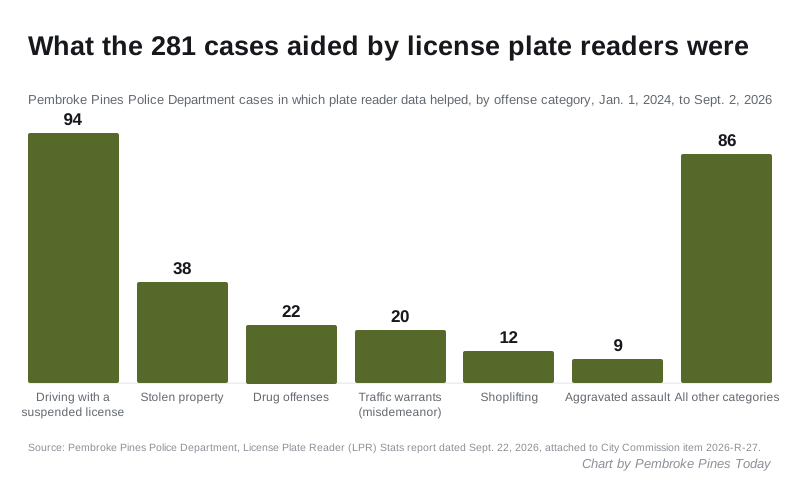
The largest single category was driving with a suspended license, with 94 cases, or 33.5% of the total. The department’s report lists these as the six largest categories:
| Offense category | Cases | Share of 281 |
|---|---|---|
| Driving with a suspended license | 94 | 33.5% |
| Stolen property offenses | 38 | 13.5% |
| Drug offenses | 22 | 7.8% |
| Misdemeanor traffic warrants | 20 | 7.1% |
| Shoplifting | 12 | 4.3% |
| Aggravated assault | 9 | 3.2% |
The other 86 cases were spread across more than 30 categories. They include five robberies, three motor vehicle thefts and three cases of murder and non-negligent manslaughter.
A second police document attached to the item lists 52 sample investigations where reader data helped, including homicides, armed robberies and a string of car break-ins in Pasadena Lakes. The department says those samples are highlights, not a representative record.
What it means for you
- The city’s plate readers are not in use. The resolution records the Sept. 1 suspension. It does not say when, or under what rules, the program might return.
- Nothing changes in law yet. A resolution states the commission’s position. Any new rules on plate reader data would have to come from the Legislature or Congress.
- You can weigh in. Pembroke Pines residents are represented in Tallahassee by the Broward County legislative delegation, which is on the resolution’s mailing list.
Also decided Wednesday
The commission approved these items on its consent agenda:
- a $21,356 federal Victims of Crime Act grant for victim services
- an agreement for a city police officer to serve as school resource officer at Renaissance Charter School, with the school paying the full $213,328 cost for 2026-27
- the Pembroke Pines Charter Schools safety assessment, threat management policy, emergency plan and package screening policy, and an application for a school hardening grant
- up to $1,440,000 for Neptune water meters, equipment and software from Ferguson Enterprises over two years
- up to $693,269.69 over three years for a Cisco network renewal from Presidio Networked Solutions
Schwartz also brought an item to discuss a “taxpayer bill of rights” ordinance that would limit growth in city operating spending. The record shows no action was taken. The full list of items and votes is in the Oct. 7 meeting record.
For arrests and calls in the city, see our Police and Fire log.
Have your say